
What do I need to get married in Mexico? For a legal civil wedding in Quintana Roo, you will typically need valid passports, apostilled documents with certified Spanish translations, prenuptial blood tests done in Mexico, four witnesses, and a ceremony performed by a Registro Civil judge. Many couples skip that process, marry legally at home, and hold a symbolic ceremony in Mexico instead.
Both paths lead to a beautiful wedding day. The difference is paperwork, timing, and cost. Here is how each one works, so you can choose with clear eyes.
Only a civil ceremony is legal in Mexico
In Mexico, a marriage is legally valid only when it is performed by the civil registry, the Registro Civil. A church or other religious ceremony on its own has no legal effect, according to the US Embassy in Mexico. Couples who want a religious ceremony usually pair it with a civil one or with a legal marriage at home.
Each Mexican state sets its own marriage rules, and municipalities set their own fees and office procedures. Cancun’s civil weddings go through the Registro Civil of the Benito Juarez municipality, in the state of Quintana Roo.
Same-sex couples can marry in every Mexican state. Tamaulipas became the last state to change its law in October 2022.
Legal requirements for foreigners in Quintana Roo
The lists below are based on current requirement sheets published by municipal Registro Civil offices in Quintana Roo, plus guidance from resort wedding departments in Cancun. Exact items vary from office to office, so treat this as an overview, not a checklist to file on your own.
Documents
- Valid passports for both of you, plus copies.
- Proof of legal stay in Mexico, which for most visitors is the tourist permit (FMM) issued on arrival.
- Birth certificates, apostilled in the country that issued them. Some Quintana Roo offices require them for all foreign couples; others ask for them only if your parents’ names should appear on the marriage record.
- Divorce decree or former spouse’s death certificate, apostilled and translated, if either of you was married before.
- A registry application form and a signed statement that neither of you is currently married. Both are supplied by the Registro Civil.
- A certificate showing you are not registered as a debtor of child or spousal support (Constancia de Inexistencia de Registro de Deudor Alimentario Moroso). Quintana Roo offices list this for each partner, and it carries its own fee.
Apostille and certified Spanish translation
An apostille is the certificate that makes a public document valid in another country that belongs to the Hague Apostille Convention. In the US, it is usually issued by the Secretary of State of the state that issued your birth certificate.
Foreign-language documents must then be translated into Spanish by a perito traductor, an expert translator authorized by the Superior Court of Justice of Quintana Roo. A standard certified translation from home will not be accepted. Your planner or resort wedding department usually arranges this.
Blood tests and medical certificates
Both partners need prenuptial medical certificates with lab work done in Mexico. Quintana Roo requirement sheets list blood type (Rh factor), HIV, and VDRL, a syphilis screening test. One municipal office states the certificates are valid for 15 calendar days, so the tests are done shortly before the wedding.
Witnesses
Plan on four adult witnesses with valid ID. Some offices accept guests from your wedding party; at least one Quintana Roo office asks for Mexican witnesses who can read and write. Resorts often supply witnesses when needed. Ask your planner which rule applies to your registry.
Timing
Resort wedding departments in Cancun typically ask couples and their witnesses to arrive at least three business days before a civil ceremony. That window covers the blood tests, document review, and scheduling with the registry. Weekends do not count as business days.
Previously divorced? Some Mexican states impose a waiting period of about one year after a divorce before you can remarry, unless the divorce decree says otherwise. Confirm this early if it applies to you.
Fees
Fees are set by each municipality and change each year. As one example, a 2026 Quintana Roo municipal fee sheet lists a little under 7,500 pesos for a marriage at the registry office and a bit more for a ceremony held off-site. Add translations, lab tests, and apostilles, and published estimates for the full legal process run roughly $700 to $2,000 or more. See our Cancun wedding cost guide for how this fits into the overall budget.
After the ceremony
The judge registers your marriage and the Registro Civil issues the marriage certificate (acta de matrimonio). To use it at home, you will usually need a certified copy with an apostille, followed by an English or French translation. Resort wedding departments note that receiving the apostilled certificate can take up to a few months.
How a Mexican marriage is recognized back home
United States
The US Department of State says marriages legally performed abroad are generally recognized as valid in the US. US consular officers do not perform marriages. Questions about a specific marriage go to the attorney general of the state where you live. With the apostilled and translated certificate, you can update records such as your name with the agencies that need it.
Canada
The Government of Canada says marriages legally performed in a foreign country are usually valid in Canada, and Canadians do not need to register them there. Its marriage outside Canada page also notes that local authorities may request documents such as a birth certificate, a single status statement, or a premarital blood test certificate. Canadian consular officials do not perform or attend weddings.
If you live elsewhere, check with your own government before you travel.
The symbolic ceremony option
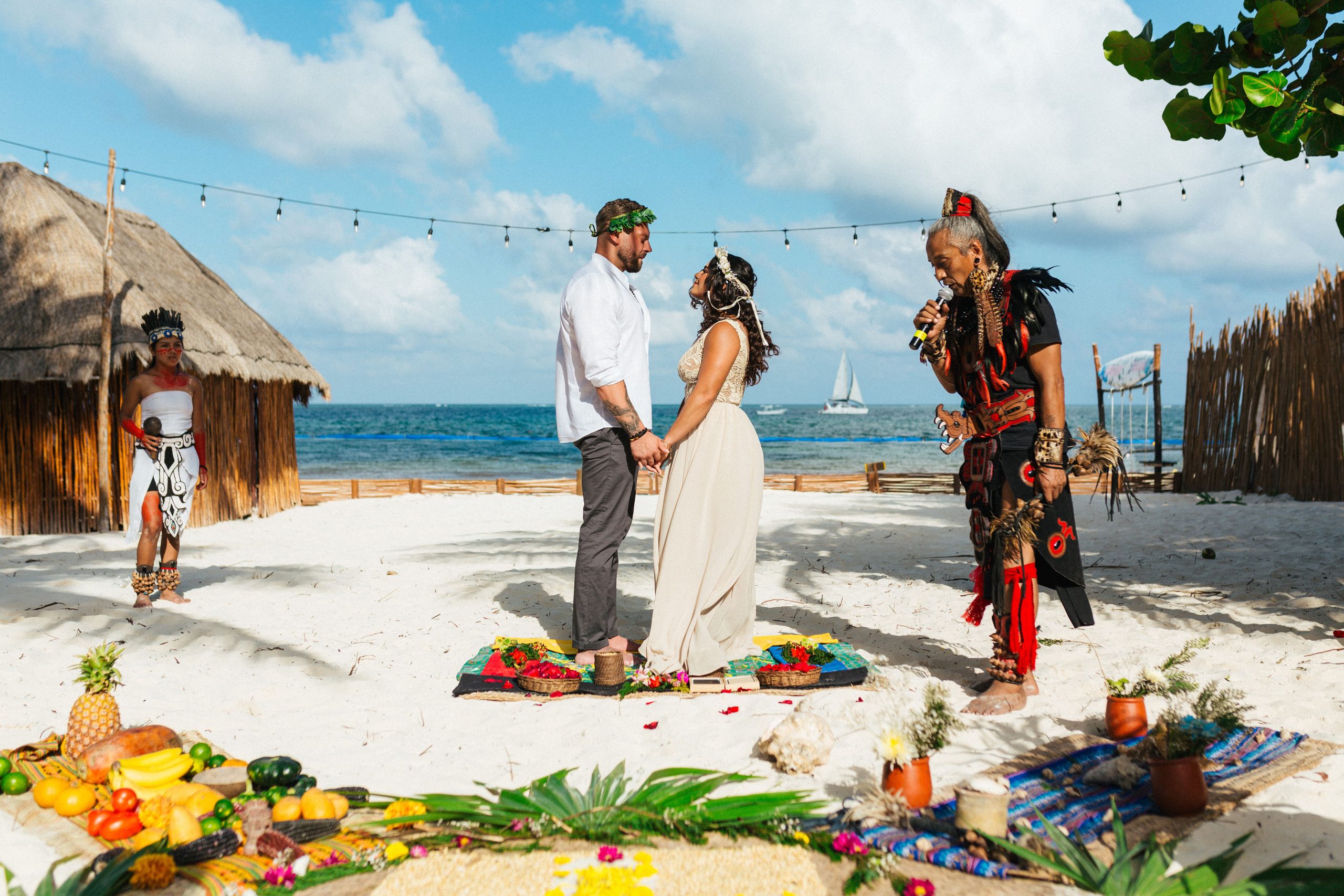
A symbolic ceremony looks and feels like any other wedding: an officiant, vows, rings, a first kiss, and a party afterward. The only difference is that it carries no legal weight. You make it official at home, either before or after the trip, usually at a courthouse or with a local officiant.
Many destination couples choose this route. It keeps the trip relaxed and removes paperwork deadlines from your vacation.
Legal vs symbolic: pros and cons
Legal civil ceremony in Mexico
- Pro: Your wedding date in Mexico is your legal anniversary.
- Pro: One ceremony covers both the legal and the emotional moment.
- Con: Apostilles and certified translations must be ready weeks ahead.
- Con: Blood tests, document review, and an earlier arrival use up vacation days.
- Con: The legal part is led by a Registro Civil judge, so you have less control over the script.
- Con: Extra fees, and the final certificate can take months to reach you.
Symbolic ceremony in Mexico
- Pro: No Mexican paperwork, blood tests, or legal fees.
- Pro: Any officiant, any language, and vows written entirely by you.
- Pro: You can arrive closer to the date.
- Con: You need a second, short legal step at home.
- Con: Your legal anniversary may differ from your celebration date.
Which should you choose?
Choose a civil wedding if having your legal marriage happen in Mexico truly matters to you, and you have time to prepare documents. Choose symbolic if you want a simpler trip, your own officiant, or full freedom over the script.
For a symbolic ceremony, the setting is entirely up to you. Our private beachfront venue in Puerto Morelos hosts symbolic ceremonies and vow renewals on the sand, one wedding at a time. You can see real setups in the gallery.
A note on changing requirements
Registry rules in Mexico change, and offices within the same state ask for slightly different things. Before you order apostilles or book flights, confirm the current list with the Registro Civil that will marry you or with your wedding planner.
Frequently asked questions
Is a symbolic wedding in Mexico legally binding?
No. A symbolic ceremony has no legal effect anywhere. Couples complete a civil marriage at home before or after the trip.
Can we have a religious ceremony in Cancun?
Yes, but in Mexico a religious ceremony alone is not a legal marriage. Pair it with a civil ceremony or a legal marriage at home.
How early should we arrive for a legal wedding in Cancun?
Resort wedding departments typically ask for at least three business days before the ceremony, for blood tests and paperwork. Your registry may ask for more.
Do our witnesses have to be Mexican?
It depends on the office. Some Quintana Roo registries accept any adult with valid ID; at least one asks for Mexican witnesses. Your planner can confirm.
Plan your ceremony
Legal or symbolic, the right setting makes the day. For more on planning, read our guide to destination weddings in Cancun, then contact us to check availability for your date.